
|
|
Dear Friend of the IRR, Why does the government pay its employees so much? How does this impact you? And what can you do about it? This month, leading up to the National Budget Speech being delivered by Finance Minister Enoch Godongwana later today, we've been reflecting on how the government manages South Africa's money. Today, we look at the civil service wage bill. Why is the civil service wage bill so high?
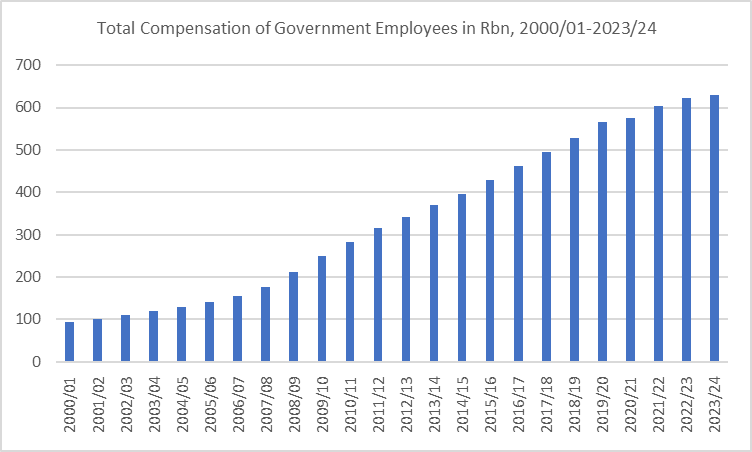
The civil service wage bill is the total amount of money the government spends on salaries, wages, and related benefits for employees in the public sector. The bill has ballooned from R93 billion in 200/2001 to R62 billion in 2022/2023 - a six-fold increase in just two decades.
Source: National Treasury; Own Analysis Much of this increase is not because the government has hired more civil servants, but because it is paying them a lot more. Between 2015/16 and 2021/22, for example, the number of civil servants increased by just 0.2% per year on average, while salaries and wages increased by 6.2% per year on average – well above inflation. Although their members were already being well paid, most of South Africa's public sector unions demanded a 7.5% wage increase in 2023 and got it after 5 months of strike action. This increase is part of a two-year, multi-term deal, and is significantly higher than what the government factored into its 2023 budget. The deal cost the government (taxpayers) an additional R23.6 billion over and above what it had budgeted for the civil service wage bill. South Africa's civil service wage bill is substantially higher than that of its peer countries, and one of the highest among emerging markets. It is about 3.5 percentage points higher than countries that are members of the Organisation for Economic Co-operation and Development (OECD). Who is paying for it?
You as a taxpayer are bearing the burden of government overspending on public sector wages. Moreover, while higher wages benefit the public sector employees in the short term, their low productivity and growing demands on the tax base are dragging down South Africa's economic performance. Low economic growth leads to high budget deficits and public debt levels, making the wage bill less sustainable and ultimately leading to job cuts and hiring freezes, as we've already seen at the provincial level. This affects the job security and future incomes of public sector employees themselves. What can you do about it?
Support parties and politicians that have a plan to make the public service work better through policies that, for example:
These are all policies the IRR is promoting with your support. Forward this email to your friends and family and encourage them to join you in supporting the IRR.
|


|
Become a friend of the IRR
|
